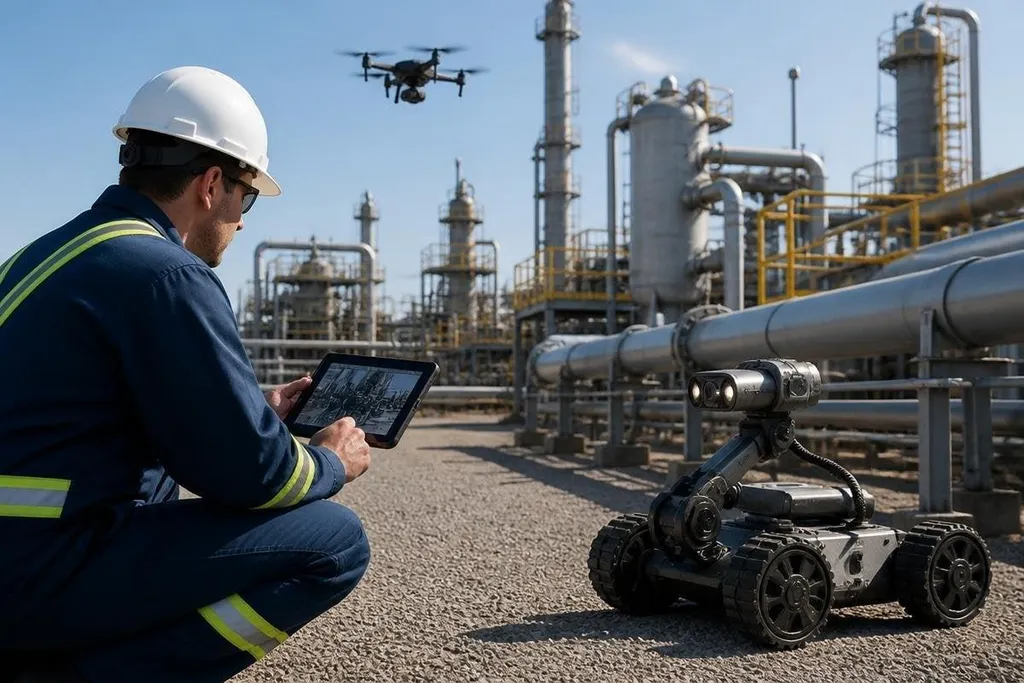
Oil and gas robots already inspect pipes, tanks, wells, and offshore equipment. AI changes their role by helping them sort sensor data, spot unusual readings, and decide which areas need human review.
- Inspection: cameras, thermal sensors, LiDAR, and ultrasonic tools collect the raw data.
- Analysis: AI compares new readings with set limits or earlier inspections.
- Human control: operators still approve repairs, safety actions, and major decisions.
Where AI fits the robot
A robot in an oil or gas site may collect more data than a person can check during one shift. A crawler can record video along a pipe, a drone can inspect a flare structure, and an underwater robot can scan subsea equipment. AI gives that data a first pass.
The software can label visible damage, flag changes in temperature, or mark a pipe section for closer review. It can also sort readings by location, so an operator sees the suspect area instead of searching through hours of footage.
That process works best when the task has a clear signal. A thermal camera can show an unusual heat pattern. An ultrasonic sensor can measure wall thickness. LiDAR can build a 3D map of a structure.
The AI still needs a person to check whether the reading means corrosion, dirt, a sensor error, or a normal change in the equipment.
What changes for inspection teams
For inspection teams, the software can reduce the amount of footage an inspector must review by sending the highest-priority sections to the front of the queue. The time saved depends on the robot, the sensor, the site, and the quality of the training data. A model trained on one type of pipe may perform poorly on another.
This matters for remote sites. An operator may need to review data from an offshore platform or a long pipeline without visiting the location. The robot collects the evidence, while the software sorts it and gives the operator a place to start.
The same setup can support repeat inspections. If a robot records the same route with the same sensor position, a later inspection can be compared with the earlier record. That comparison may show a crack growing, a coating changing, or a hot spot appearing where none existed before.
Autonomy has a narrow job
The software can help a robot choose where to look next, but site conditions can change quickly. Dust may block a camera. Water can affect an underwater scan. Reflections can confuse image software. A robot can also lose its position near metal structures or in places where satellite signals do not work.
For that reason, a practical system gives the robot a limited task and a clear stop rule. The robot may follow a mapped route, avoid marked areas, or return to its charging point when its battery reaches a set level. A human operator stays responsible for exceptions.
The safety case matters as much as the model. A company needs records showing which sensor produced a finding, when the reading was taken, and who approved the next action. An AI score without that record is hard to use in maintenance planning.
For an oil and gas team, Robot24.com's oil and gas robotics coverage can connect an inspection robot's model, site, test date, sensor, and measured result before the article turns to what remains unproven.
What remains unproven
Pattern matching can spot unusual readings, but it doesn't understand every cause behind them. A false alarm can send a technician to a remote site for no reason. A missed defect can delay a repair. The cost of either error depends on the equipment and the inspection task.
Training data also limits the system. Images from clean, well-lit pipes won't cover every condition inside a refinery. Data from one camera may not match data from another model. Weather, coatings, rust, water, and poor access can change the result.
I'd treat AI as an inspection aid until a company shows repeatable results on the exact equipment and conditions you care about. A demo in a clean test area says little about a corroded pipe behind a structure.
A practical buying checklist
Before choosing an AI inspection robot, check these points:
- Name the defect: define the crack, leak, heat change, or wall loss the system must find.
- Match the sensor: confirm that the camera, ultrasonic tool, thermal sensor, or LiDAR fits the task.
- Test site data: run the model on images and readings from your own equipment.
- Record each finding: keep the location, sensor type, timestamp, and operator decision with the result.
- Set a human stop: define when the robot pauses, returns, or hands control back to an operator.
- Price the full work: include training, repairs, data storage, inspection review, and site access.
The useful question is not whether AI can run an oil and gas robot alone. Ask whether it can find the right evidence sooner, under the conditions your inspection team faces, and leave a record that a person can check.